

At-a-glance summary of where we are and what we can do
Below is a summary of where we are with the different disputes. At the end we discuss what we can do about it: a winnable strategy that makes success possible, as shown by 31 UCU branches for whom it already worked.
If you have questions about the dispute that are not answered here, get in touch at ucu@ucl.ac.uk
Cost of living crisis: Inflation is skyrocketing, with levels of over 12% and rising. At the same time, our employers have imposed a pay “offer” of 3% (a real-terms pay cut of at least 9%). The HE employers’ approach of imposing real-terms pay cuts nearly every year since 2009 has reduced our salaries by 25%. We now face a pay cut of 10-20% next year. We have members facing serious hardship due to energy price rises. The cost of living crisis will have a terrible impact on all of us unless we can secure protection against inflation from employers.
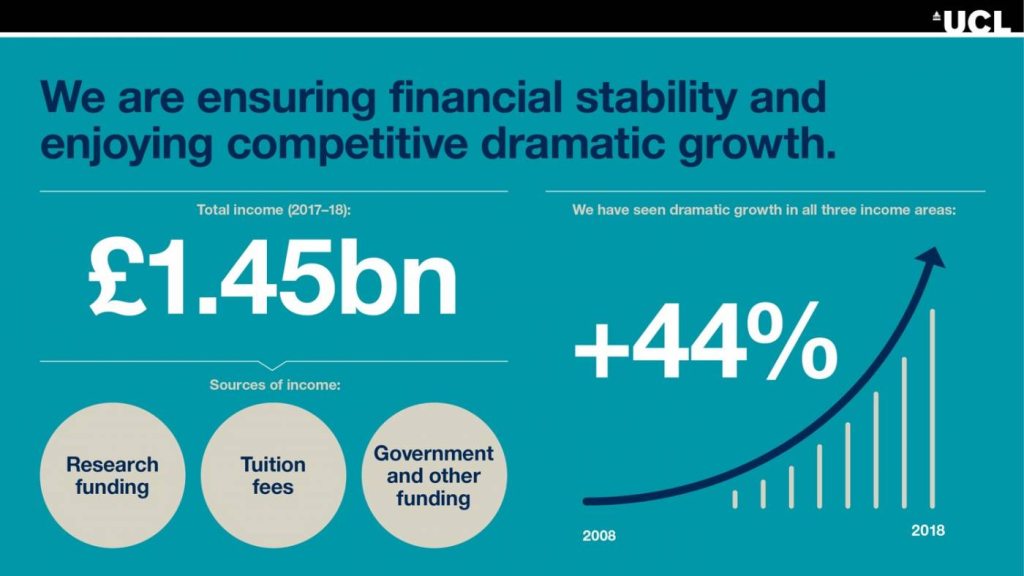
The employers, on the other hand, have been making massive surpluses by expanding student numbers and our workloads. The percentage of UCL’s budget spent on total staff costs (salary and pension contributions) fell from over 70% in the 1970s to 55% in the last financial report.
UCL even boasts how well we’re doing.
Pensions: In April, the employers’ representatives pushed through massive (estimated 30-40%) cuts in the future value of USS pensions, based on a valuation method that is absurdly conservative – it is justified by assuming that the entire HE sector went bankrupt overnight, so the scheme had to shut down in an unplanned way!
The valuation used by the employers to engineer cuts showed a projected deficit of £14 billion. But the pension scheme is now, 18 months later, showing a surplus of £1.8 billion. The reason for the change? The assets increased in value by some £20 billion in two years, and long-term gilt yield rates rose (the ‘bankruptcy’ model of valuation is dependent on this variable). Not only are we losing benefits, but one fifth of all contributions paid into USS now pay ‘deficit recovery contributions’ for a deficit that USS says no longer exists.
Universities UK (who cut our pensions) and USS (who helped them do it), claim that the reason the pension scheme is in surplus is because of the cuts to our pensions. But, as these graphs developed by researchers at Sussex University UCU, show, the difference in surplus with the cuts vs without is marginal (1%).
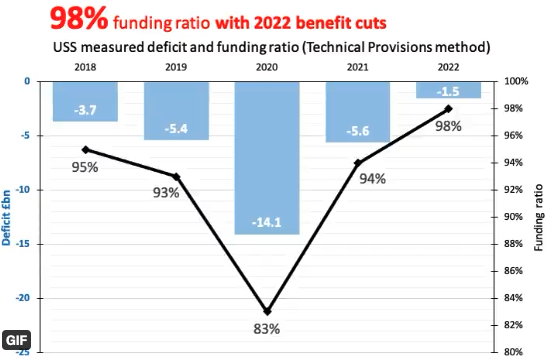
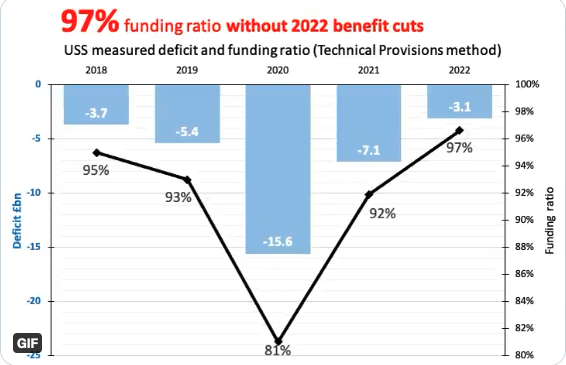
If the employers chose to, they could reverse the cuts at zero cost to themselves. But they are refusing to act. They have allowed USS Limited to charge much more for a more meagre pension, pocketing the equivalent of hundreds of thousands of pounds of pension from each member by the time they retire. The employers’ aim is to destroy the ‘defined benefit’ pension (i.e. an actual pension with a known value) and replace them with ‘defined contribution’ schemes (i.e. not really a pension, but a stocks-and-shares savings fund which could go down in value).
Inequality and job insecurity: At the same time, race and gender inequality in pay and advancement in our sector continues unabated. Job security continues to be eroded with over 90,000 people being exploited on insecure contracts. Yet the employers refuse to get round the table to discuss the concrete proposals the union has put forward to address this.
At the same time universities have been raking in massive surpluses from increasing student numbers and are proposing to spend these on… new buildings and vanity projects.
Can we change this, and if so, how? Yes, we can. 31 UCU branches this year have achieved significant victories by using the tactic of marking boycotts backed up with the threat of strike action, should employers seek to make punitive pay deductions. In only one case did the employers try this (QMUL) and there, in the end, they were forced to concede the dispute anyway. The evidence is that a disruptive tactic like this works, and it is in our power to use it to save this sector from the degradation the employers continue to cause.
The following 31 UCU branches took part in a marking and assessment boycott this summer: Anglia Ruskin, Bath Spa, Bedfordshire, Bournemouth, Brighton, Bristol, Cambridge, Durham, Edinburgh, Exeter, Glasgow, Gloucestershire, Heriot Watt, IDS at Sussex, Loughborough, Kings College London, Kingston, Leeds, Leeds Beckett, Manchester, Napier, Nottingham, Oxford, Queen Mary University of London, Sheffield, SOAS, Sunderland, Sussex, University of the Arts London, Ulster, York.
They achieved remarkable success – often against management intransigence – in forcing concessions from local employers. The wins:
- 9 branches won commitments to convert HPL / casual contracts to permanent / minimum length / fractional contracts. Ulster won an end to zero hours contracts. Nottingham won reduced use of outsourced temporary contracts. Sussex won paid holidays, training and sickness leave for temps. Heriot Watt won contract reviews for all HPLs on request.
- 12 branches won work groups on discrimination/pay gaps.
- 10 branches won action to cut stress and overwork. Sussex, Durham, Nottingham gained overtime pay and/or credit for admin roles. Newcastle won a reduction of hours to 37pw.
- 24 branches negotiated non-consolidated pay top-ups. Sussex, Durham, Brighton won an increase in F/T staff on time-limited contracts. Leeds & Heriot Watt won pay grade reviews. QMUL won a 21% increase in their London Weighting supplement.
- 12 branches secured positive joint statements from management on USS pension benefits.
- 11 branches forced USS governance reform.
- 8 branches won the principle of equal covenant support for UCU & UUK proposals to USS.
The impact of this boycott shows how effective united action can achieve significant results.